
All Topics
- Alchemizing Music Concepts for Students
- Anuv Jain Songs
- Artist Spotlight
- artium gift card
- Artium Maestros
- Artium News
- Artium Practice Studio
- Artium Tech Blog
- Best Coke Studio Songs
- Best Female Singers
- Birthday songs
- Bollywood Love Songs
- buying guide
- Carnatic Music
- Child Singers
- Devotional Music
- Editorials by Ananth Vaidyanathan
- English Love Songs
- Festival
- Film Music
- Ghazal Music
- Guitar
- Hindustani Classical Music
- Indian Classical Music
- Indian Folk Music
- Insights
- Instagram Reels Viral Songs
- Instruments
- Karaoke
- Karaoke Singing
- Keyboard
- Kids Music
- maestros
- Music Education
- Music for Kids
- Music Games
- Music Industry
- Music Instruments
- Music Legends
- Music Press Release
- Music Technology
- Music Theory
- Music Therapy
- Music Tools
- Piano
- piano guide
- Songs
- South Devotional Music
- Success Stories
- Tamil Film Music
- Tamil Singers
- Telugu Film Music
- Telugu Singers
- Tools
- Uncategorized
- Uncategorized
- Uncategorized
- Uncategorized EN US
- Vocal Range
- Vocal Singing
- Vocals
- western classical music
- western music
- Western vocal music
Instruments, Music Instruments
Pakhawaj Instrument Explained: History, Sound, and Players
Pakhawaj Instrument Explained: History, Sound, and Players
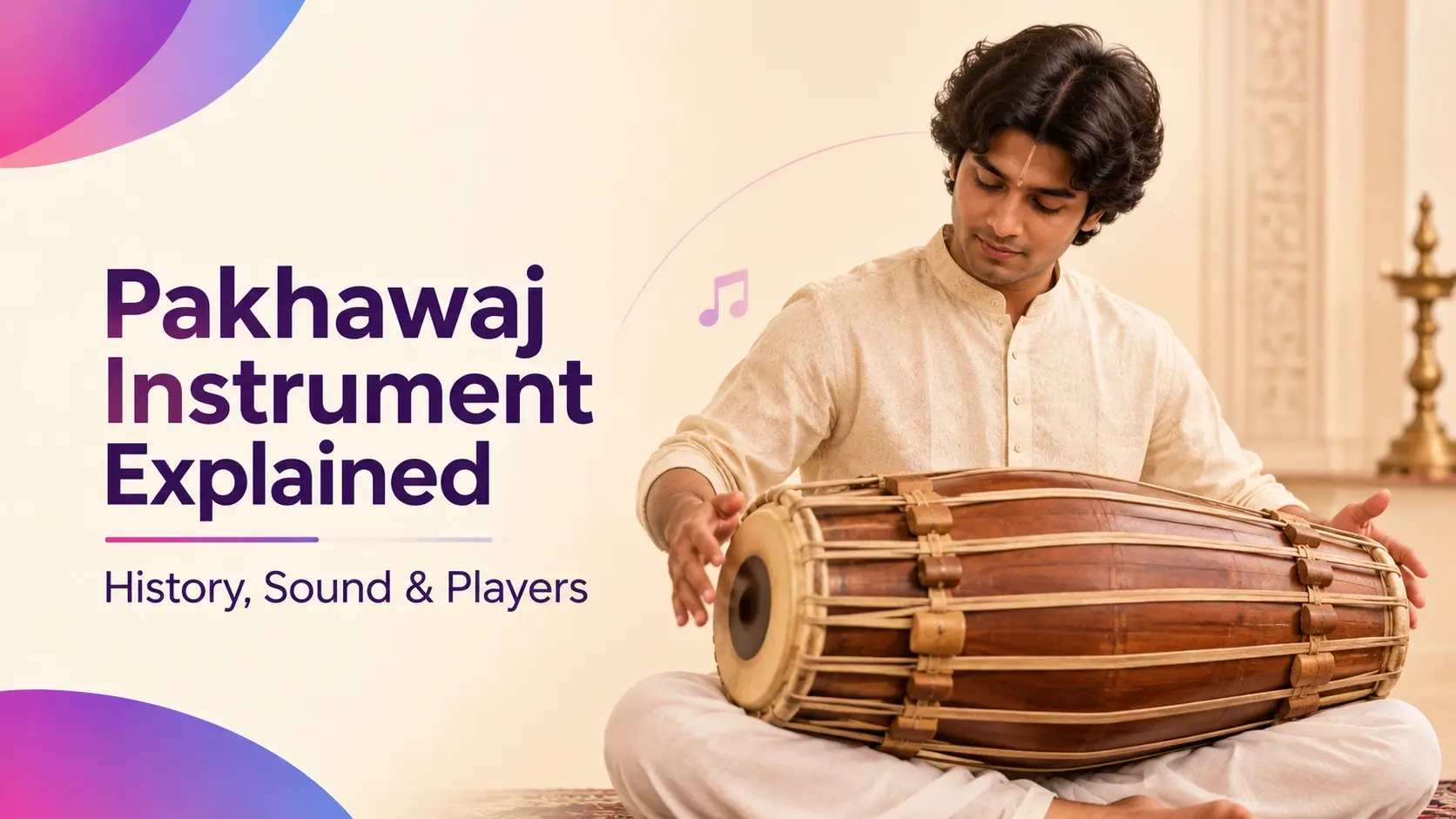
Table of Contents
Quick Summary
| Pakhawaj is a barrel-shaped, two-headed hand drum originating from North India, most often used with dhrupad and Hindustani classical music. Deep, resonant bass and explosive open-hand strikes differentiate the pakhawaj from its modern percussion counterparts the tabla and mridangam. Pakhawaj instruments are typically made of wood, leather, and tuning blocks, and are played lying horizontally across the lap with hands. As a musical instrument, the pakhawaj continues to be used in classical, devotional, and modern Indian music, with notable players including Raja Chhatrapati Singh and Rishi Shankar Upadhyay. |
Introduction
The pakhawaj is one of India’s most prominent drums. Before the tabla took dominance of North India, the pakhawaj was responsible for the beats underpinning dhrupad, the oldest surviving form of Hindustani classical music. The instrument has a deep, earthy, heavy tone that’s nowhere near as sharp as the tabla but equally powerful.
You might think of the pakhawaj as a big drum played like a drum sitting on the lap, but it has a complex language of hand gestures, syllables, and metrical cycles. By learning the history, mechanics, and musicality behind the pakhawaj, you might understand why it still captivates musicians.
Pakhawaj Meaning and Overview
The definition of pakhawaj is often given as “side drum,” a “drum that’s played from the side,” or similar. It’s also written as pakhavaj, and sometimes considered a North Indian version of the mridang family of barrel drums.
A pakhawaj musical instrument consists of a single wooden barrel with two heads of stretched membrane. One end of the instrument produces a bass or lower tone sound, whereas the other has a clearer treble or higher tone sound. The musician would sit with the pakhawaj laid horizontally with both palms, fingers and edges of hands used to produce various sounds.
Basically, it’s more than a timekeeper drum. It has rhythm, texture, and expression. In a dhrupad concert, it can support long, meditative phrases sung by the singer, and it can also throw out dramatic rhythmic patterns.
History and Origin of the Pakhawaj
The pakhawaj instrument is from a much older family of Indian barrel drums. A close cousin of the pakhawaj musical instrument in South Indian music is the mridangam and it, along with the pakhawaj, came to be a notable percussion instrument of North Indian Classical music.
In the past, the pakhawaj instrument was especially associated with the serious and exquisitely-defined style of Hindustani vocal music known as dhrupad. It was the primary drum supporting dhrupad singers and instruments that played in the dhrupad style.
Meanwhile, as khayal became the dominant form from the late eighteenth and early nineteenth centuries, the tabla slowly replaced the pakhawaj musical instrument as the traditional accompanying instrument in many regions of Hindustani music. The pakhawaj, however, did not go away. It continued to be central to dhrupad, dhamar, and a number of devotional and classical performing arts.
The true date of the pakhawaj’s creation is hard to determine, as the drum scene in India grew over hundreds of years. What we do know is that this instrument has long been an integral part of India’s musical past and is still a vital connection to today’s classical music scene.
Structure and Parts of the Pakhawaj
The musical instrument pakhawaj is a large barrel-shaped drum traditionally constructed out of a hollowed and dried piece of wood. It has a smaller parchment or leather head at each end, and these are tuned to different pitches. The musical instrument pakhawaj is usually played horizontally, while the player sits cross-legged.
Its main parts include:
- Shell or body: The interior wooden casing of the drum providing its size, resonance and tone.
- Bass side: The larger head, generally when played with the palm and base of the hand for deep, arching sounds.
- Treble side: The lower notes, played with the fingers and hand, resulting in more defining and high-pitched sound.
- Leather straps: straps along the body assist to hold the two heads in place and affect tuning.
- Tuning blocks: Tiny wood blocks positioned between the shell and straps; when moved, this alters the tension of the head.
The conventional pakhawaj musical instrument was occasionally made from clay although wood is the more popular material used today. The pakhawaj has a bass-side as well as a treble side and this creates the opposition and contrast of sound, harshness and softness, deepness and sharpness.
Difference Between Mridangam and Pakhawaj
The pakhawaj and mridangam are related barrel drums, but they belong to different musical traditions and have distinct playing styles.
| Aspect | Pakhawaj | Mridangam |
| Main tradition | Hindustani classical music, especially dhrupad | Carnatic classical music |
| Region | North India | South India |
| Sound character | Deep, open, resonant, and powerful | Bright, crisp, and highly articulate |
| Playing style | Uses open-hand strokes, palm strikes, and strong bass tones | Uses a refined finger-and-palm technique with rapid rhythmic patterns |
| Common association | Dhrupad, dhamar, and devotional traditions | Carnatic concerts and South Indian percussion traditions |
While both are played with just one resonating shell (as opposed to the two drums of the tabla), the pakhawaj traditionally evokes the scale and grandeur of dhrupad while the mridangam is at the heart of Carnatic music.
Difference Between Tabla and Pakhawaj (Pakhawaj vs Tabla)
Many students wonder about pakhawaj vs tabla as both of these instruments are vital percussion instruments for North Indian music. The main difference is in the body of the instruments. Pakhawaj musical instrument is a single, barrel shaped, 2-headed drum whereas tabla consists of two drums.
| Aspect | Pakhawaj | Tabla |
| Structure | One horizontal barrel drum with two heads | Two separate drums: dayan and bayan |
| Sound | Deep, sustained, and resonant | Clear, versatile, and rhythmically agile |
| Playing style | Uses palms, fingers, and hand edges | Uses more finger-based articulation |
| Main classical association | Dhrupad and dhamar | Khayal, thumri, instrumental music, and many modern settings |
| Rhythmic feel | Broad, grounded, and majestic | Light, quick, and highly flexible |
The pakhawaj musical instrument produces a deeper tone which sustains longer than the tabla. Its bass strokes have an appropriate accompaniment for the slow and spacious phrases of dhrupad, whereas the two-tambourine design of the tabla can be played with greater speed and rhythmic flexibility in many other styles.
There is a myth that the tabla was made by splitting a pakhawaj in two. While it is a nice story, this more than likely falls into the realm of legend, as the musical history leading to the evolution of the tabla is much longer.
How the Pakhawaj instrument Is Played
Both of the hands on the pakhawaj have playing roles. Most strokes on the treble side are typically produced by the right hand, while the larger head on the pakhawaj is hit with the left hand, creating bass notes. The pakhawaj uses the entire hand, the palm and even the edge of the hand, not just the fingers.
Hand Positions and Basic Strokes
A player sits comfortably with the drum placed horizontally across the lap. The posture should allow relaxed shoulders, flexible wrists, and steady contact with both drumheads.
Basic strokes include:
- Ge or Ghe: A bass stroke using the larger head, played with the palm or bottom of the hand.
- Na: A distinctive treble stroke made by the fingers on the smaller head.
- Ta: A striking stroke on the treble side with a resonant sound, leaning into it as a sweeping or brushing stroke.
- Tin: A ringing treble stroke which sustains longer.
- Dha: Balfala stroke played with both hands, fuller bass and treble sound.
- Dhin: A resonant combined sound, often used to produce a longer phrase of the beat.
New players are advised to work on getting a good clear relaxed sound, speed is a secondary consideration. The power in a musical instrument pakhawaj performance is achieved through wrist control, clear distinction between bass and treble strokes, and a consistent sense of rhythm.
Common Bols Used on the Pakhawaj instrument
Although similar in construction to the tabla, pakhawaj bols also have syllables which are used to recite the rhythms, apart from the strokes themselves. These syllables are used to aid memorization of specific rhythmic phrases in practice.
Common bols include:
- Dha: A combined bass and treble stroke.
- Dhin: A resonant combined stroke.
- Ge/Ghe: A bass stroke.
- Na: A clear treble stroke.
- Ta: A resonant treble stroke.
- Tin: A sustained treble stroke.
- TiTa: A pair of muted or closed treble strokes.
- Ka: A closed or damped stroke, often played with the left hand.
For example, a simple practice phrase can begin with alternating bass and treble sounds: Ge, Na, Ge, Na. When these sounds settle into consistency, the learner can join them into small phrases: Dha Ge Na Dha. Speed is not the immediate aim; clarity, balance, and comfort are.
Role of Pakhawaj instrument in Dhrupad and Hindustani Classical Music
The pakhawaj musical instrument is a traditional accompaniment instrument for dhrupad, a classical vocal style that features sustained, relatively slow, and often very meditative singing. The pakhawaj played a dominant role in dhrupad performance, providing much of the rhythmic foundation and leaving space for the vocalist to craft the phrasing.
It is also used in dhamar, another classical form connected with rhythmic play and devotional themes. Beyond the concert stage, the pakhawaj has long been associated with devotional music, where its grounded sound supports chanting, singing, and spiritual expression.
Thus, the role of this instrument in Hindustani classical music is twofold. Its purpose is not merely to maintain a beat, but it interacts with the singer, generates release and tension, and provides architectural stability to a performance.
For learners exploring traditional Indian musical instruments, the pakhawaj offers a valuable window into India’s percussion heritage. Its bols, talas, and hand techniques connect rhythm with language, memory, and musical expression.
Famous Pakhawaj Players in India
Some musicians have contributed to the preservation of this art form through performance and recordings.
- Raja Chhatrapati Singh Judeo (1919–1998): A renowned Indian percussionist known for his virtuosity on the pakhawaj in Hindustani classical music.
- Shankarrao Ghorpadkar: A respected pakhawaj musical instrument exponent associated with the tradition of Ramashankar Panse, who is regarded as one of the most celebrated exponents of the instrument.
- Rishi Shankar Upadhyay: A contemporary pakhawaj artist from a family with a long musical lineage connected to Rajasthan.
These artists represent different generations of pakhawaj playing. Their experience demonstrates that the pakhawaj instrument is still an active practice and that there are both teachers and performers still interested in the instrument.
Is the Pakhawaj Still Used in Modern Music?
Yes. The pakhawaj instrument, despite being overshadowed by the more popular tabla today in mainstream Hindustani music, remains a relevant instrument in dhrupad, dhamar, as well as in devotional music and certain niche classical performances.
It is also used in today’s fusion and contemporary projects where musicians require its unique depth and robust earthy feel. Its powerful bass lends itself perfectly to fusion, film, devotional and experimental music but is still more associated with classical dhrupad traditions.
So for a beginner, this means the pakhawaj instrument is not an old timer. It is a specialised instrument with a large vocabulary, and even learning a few sounds will give you a better understanding of Indian music.
Conclusion
The musical instrument pakhawaj is a majestic barrel drum with a deep historical connection to dhrupad and Hindustani classical music. Its two-headed design, resonant bass, expressive bols and open-hand technique make it very different from the tabla and mridangam.
Whether you are a parent exploring music education, a vocalist wanting to understand rhythm better, or a hobbyist returning to music, the pakhawaj offers a beautiful way to connect with India’s classical heritage. Its sound may be ancient in character, but its presence in modern performance shows that traditional instruments can continue to evolve with time.
Ready to learn singing with us? Book your free 1:1 trial class with Artium Academy and learn from certified teachers at your own pace.
Frequently Asked Questions
The musical instrument pakhawaj is used mostly in North Indian classical music in dhrupad or dhamar. It is a barrel-shaped or two-headed hand drum played in devotional music and in other modern contexts.
While the mridangam is linked to south Indian Carnatic music, and the pakhawaj with North Indian Hindustani music and dhrupad. They are both barrel drums, but the sound, the technique and their use in the music varies.
The musical instrument pakhawaj is a single horizontal barrel-shaped drum that has two heads, in contrast to the double-head division into two separate drums of the tabla. The pakhawaj produces a richer, more resonant sound but the tabla is more nimble.
Some of the famous names are Raja Chhatrapati Singh Judeo, Shankarrao Ghorpadkar, and Rishi Shankar Upadhyay. They have done much to maintain and propagate the musical instrument pakhawaj tradition.
The musical instrument pakhawaj is an Indian barrel-drum instrument that historically dates back to centuries of Indian tradition, yet there is not a single definitive date of pakhawaj’s origin given by scholars, but has been linked to dhrupad, and ancient Indian rhythms.
It may be difficult because it involves two hands together, bass and treble sound on an intricate rhythm cycle. But beginners may also begin with small strokes, basic bols, and practice slowly and easily.
A musical instrument pakhawaj is traditionally composed of a hollow, wooden body, leather or parchment heads, leather straps, and tuning blocks of wood. An earlier variety is occasionally constructed of clay.
It is spiritually known to be used in dhrupad, dhamar, HIndustani classical music, and bhajan and devotional music. The rhythm feel is provided to the song along with the idea of embellishing voices with violin, harmonium.
The player rests the drum across her lap, placing it horizontally. The right hand largely plays treble strokes and left hand bass strokes; loose wrists, a good seating position and economical hand motion are the key.
Yes. While the tabla is more widely used in modern Hindustani, the pakhawaj retains its importance in dhrupad, and makes appearances in devotional music, classical music and modern collaborations.