
All Topics
- Alchemizing Music Concepts for Students
- Anuv Jain Songs
- Artist Spotlight
- artium gift card
- Artium Maestros
- Artium News
- Artium Practice Studio
- Artium Tech Blog
- Best Coke Studio Songs
- Best Female Singers
- Best Male Singers
- Birthday songs
- Bollywood Love Songs
- buying guide
- Carnatic Music
- Child Singers
- Devotional Music
- Editorials by Ananth Vaidyanathan
- English Love Songs
- Festival
- Film Music
- Ghazal Music
- Guitar
- Hindustani Classical Music
- Indian Classical Music
- Indian Folk Music
- Insights
- Instagram Reels Viral Songs
- Instruments
- Karaoke
- Karaoke Singing
- Keyboard
- Kids Music
- maestros
- Music Education
- Music for Kids
- Music Games
- Music Industry
- Music Instruments
- Music Legends
- Music Press Release
- Music Technology
- Music Theory
- Music Therapy
- Music Tools
- Piano
- piano guide
- Songs
- South Devotional Music
- Success Stories
- Tamil Film Music
- Tamil Singers
- Telugu Film Music
- Telugu Singers
- Tools
- Uncategorized
- Uncategorized
- Uncategorized
- Uncategorized EN US
- Vocal Range
- Vocal Singing
- Vocals
- western classical music
- western music
- Western vocal music
Margazhi 2026: A beginner’s guide to Carnatic ragas to know before the December season
Margazhi 2026: A beginner’s guide to Carnatic ragas to know before the December season
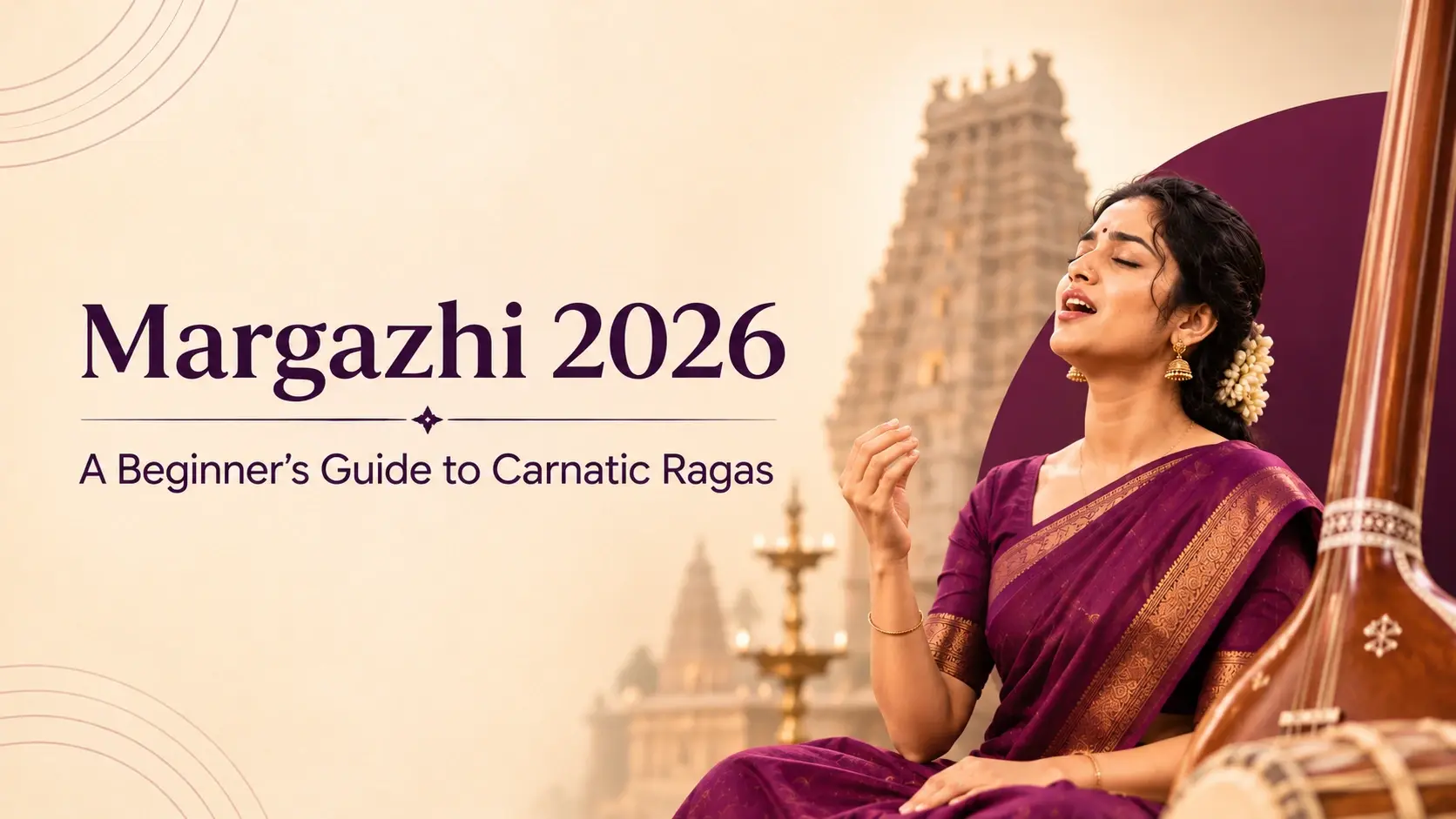
Table of Contents
Quick Summary
| Ten Carnatic ragas that beginners should know before Marghazi 2026! Mayamalavagowla, Shankarabharanam, Kalyani, Todi, Bhairavi, Kharaharapriya, Mohanam, Hamsadhwani, Hindolam and Abheri. And don’t forget the Madhyamavati, which often concludes a concert. You’ll hear these ragas again and again in the December season concerts and there’s a well-known kriti for each you can learn to identify. Learn the scale for each, hum one kriti per raga and you’ll be able to enjoy the concerts with much greater pleasure. (Start with Mayamalavagowla and Mohanam and learn one additional raga every couple of days). |
Introduction (Margazhi, also spelt Marghazi)
Ever wondered why the entire city gets up before dawn to listen to music? Welcome to Margazhi (also spelt Marghazi), the ninth month in the Tamil calendar, that occurs from mid December to mid January and is a traditional month for devotion, fresh kolams adorn the floors in the mornings, temples are filled with Tiruppavai and Thiruvempavai and the mornings feel cool, tranquil and a little magical.
This energy was to become the December music season in Chennai. Sabhas organise music concerts and dance recitals every day from dawn till midnight, and rasikas schedule the entire day to listen to their idols.
If you’ve ever felt lost the moment the singer started an alapana, take a deep breath. You don’t need decades of training to appreciate it. A little bit of rote work with ragas goes a long way, like getting to know the main characters in a movie.
What Is Margazhi (Marghazi)? The Chennai December Music Season Explained
Meaning of Margazhi and Why the Season Matters
Margazhi, the ninth month of the Tamil solar calendar coinciding with mid-December to mid-January marks a month of devotion, kolams at dawn, bhajans in the early mornings, taking in the Tiruppavai. What originated as a neighbourhood ritual went on to become a full-fledged music and dance season in Chennai, where seasoned rasikas and emerging artistes, as well as first-time audiences, sit together. For students, it’s a rare opportunity to hear the music you practice day-in and day-out performed LIVE!
A Short History of the Madras Music Season
The origin of the season is generally said to be in 1927, with the establishment of the Madras Music Academy. Many other sabhas (music organizations) came into being over the years, and the “Madras Music Season” grew to be the Chennai December season of today.
Marghazi 2026: Dates, Venues, and Schedule
When Does Marghazi 2026 Begin and End?
The Tamil month of Margazhi is calculated to be from 16 December 2026 to 14 January 2027. Concert timings The concert timings are a little different. Each sabha releases its own schedule and many concerts take place before mid-December itself and even go on till the end of January.
Major Sabhas and Venues
The big halls include the Music Academy, Narada Gana Sabha, Bharat Kalachar, Bharatiya Vidya Bhavan and Sri Parthasarathy Swami Sabha, along with a whole lot of smaller halls. They’re mostly concentrated in and around Mylapore, Alwarpet and T. Nagar, so you can easily spend the entire day enjoying a whole string of concerts in one day.
Concert Timings, Tickets, and Free Concerts
Most sabhas offer daytime and late evening concert times, with the most senior artists playing during the evening. The rules about tickets and passes are different at every sabha, so check with them before you attend, some sell seats, others offer season passes or free programmes.
Why Learn Ragas Before You Attend a Margazhi Concert?
A raga is a melodic framework, A collection of notes, with a personality, a mood, and specific phrases associated with it. Nearly everything you hear in a concert, from the first song to the elaborate improvisations, is based on one or more ragas. As you start to identify some of them, the alapana will no longer be an enigma, but feel more like a chat. You’ll also notice when the singer transitions between ragas, which is a great guide to enjoyment at live concerts.
How a Carnatic Concert Is Structured (Varnam, Kriti, Alapana, Neraval, Kalpanaswaram, Ragam Tanam Pallavi, Tani Avartanam, Thukkadas)
Every concert is a little different, but most follow a familiar flow:
- Varnam: Warm-up is a quick, a little structured opening song that prepares the voice and creates atmosphere.
- Kriti: a lyric song that forms the main body of a concert. They will be the best of the entire night.
- Alapana: a slow, unmetered, melodic improvisation performed without words.
- Neraval: the musician repeats a kriti line, embellishing it with fresh melodic phrases.
- Kalpanaswaram: improvised melodic phrases that always return to a pre-determined note or set of notes.
- Ragam Tanam Pallavi (RTP): an important improvisation piece comprising a raga alapana, a rhythmic tanam passage and a pallavi line elaborated in several permutations and combinations.
- Tani avartanam: percussion solo by mridangam and its accompanists.
- Thukkadas: lighter closing items like bhajan, devotional songs and short compositions.
10 Carnatic Ragas You Will Hear in Margazhi 2026
These ten ragas are regularly played in Carnatic concerts and provide you a good foundation in the season. Here is the scale, the emotion and a famous song for each, with the link to listen.
1. Mayamalavagowla
- Scale: Sa, a soft Ri, Ga, Ma, Pa, a soft Dha, Ni, Sa. The soft Ri and Dha give it a distinctive pull.
- Mood: calm, devotional and grounded.
- Well-known composition: “Tulasi Dala” by Tyagaraja.
- Where you may hear it: Most students learn this raga first, so it often features in opening or early pieces in Marghazi 2026 concerts.
2. Shankarabharanam
- Scale: all seven notes in their natural form, close to the Western major scale.
- Mood: bright, grand and majestic.
- Well-known composition: “Enduku Peddala” by Tyagaraja.
- Where you may hear it: Artists often choose it for a main item with a long alapana, so it is likely to appear among the marghazi songs and kritis you hear live.
3. Kalyani
- Scale: like Shankarabharanam, but with a sharper Ma.
- Mood: joyful, uplifting and auspicious.
- Well-known composition: “Nidhi Chala Sukhama” by Tyagaraja.
- Where you may hear it: It is a favourite for the main raga of a concert or a Ragam Tanam Pallavi, so keep an ear out for it at Marghazi 2026 evening concerts.
4. Todi
- Scale: all seven notes, with a soft Ri, Ga and Dha.
- Mood: deep, serious and intense.
- Well-known composition: “Koluvamaregada” by Tyagaraja.
- Where you may hear it: Singers and instrumentalists love to spend a long time on Todi, so it often anchors the main section. It is one of the richest ragas behind many marghazi songs and concert pieces.
5. Bhairavi
- Scale: Sa Ri Ga Ma Pa Dha Ni, with a soft Ga, Dha and Ni.
- Mood: tender, emotional and devotional.
- Well-known composition: “Balagopala” by Muthuswami Dikshitar.
- Where you may hear it: Bhairavi often turns up as a main piece or in the later part of a concert, so it is a good one to practise before Marghazi 2026.
6. Kharaharapriya
- Scale: all seven notes, with a soft Ga and Ni.
- Mood: warm, graceful and expressive.
- Well-known composition: “Pakkala Nilabadi” by Tyagaraja.
- Where you may hear it: Artists often choose it for a detailed kriti or the main item, and it appears in many marghazi songs and concert programmes.
7. Mohanam
- Scale: five notes: Sa, Ri, Ga, Pa, Dha.
- Mood: pleasant, graceful and cheerful.
- Well-known composition: “Nannu Palimpa” by Tyagaraja.
- Where you may hear it: Because it is simple and loved by everyone, you may hear it at any point in a Marghazi 2026 concert, from a short piece to a longer elaboration.
8. Hamsadhwani
- Scale: five notes: Sa, Ri, Ga, Pa, Ni.
- Mood: bright, auspicious and celebratory.
- Well-known composition: “Vatapi Ganapatim” by Muthuswami Dikshitar.
- Where you may hear it: Many artists begin a concert with a Ganesha invocation in this raga, so it is one of the first marghazi songs a beginner will recognise.
9. Hindolam
- Scale: five notes: Sa, Ga, Ma, Dha, Ni, all with a soft, meditative feel.
- Mood: calm, thoughtful and soothing.
- Well-known composition: “Samaja Vara Gamana” by Tyagaraja.
- Where you may hear it: It often appears in the middle of a concert as a gentler change of mood, and you may also notice it during Marghazi 2026 sessions that include shorter pieces.
10. Abheri
- Scale: five notes going up (Sa, Ga, Ma, Pa, Ni) and seven coming down.
- Mood: soft, tender and slightly romantic.
- Well-known composition: “Nagumomu” by Tyagaraja.
- Where you may hear it: Abheri is a favourite for mid-concert kritis, and its gentle charm is easy to spot among marghazi songs and lighter pieces.
Bonus: Madhyamavati, the Raga That Traditionally Closes a Concert
- Scale: five notes: Sa, Ri, Ma, Pa, Ni.
- Mood: peaceful, auspicious and complete.
- Where you may hear it: A lot of concerts close with a short mangalam in this raga. If you hear it at the top of the last piece in a Marghazi 2026 concert, you’ll realize the night is nearly over.
How to Recognise a Raga: Listening Tips for Beginners
Identifying a raga is practice, not talent. Here’s how:
- Learn the notes first. Sing the simple scale of each raga for a slow tempo so you become familiar with the pattern in your ear. Our guide to ragas in carnatic classical music is a good starting point.
- Anchor each raga to one song. Choose one piece in each raga and play it multiple times. That is the one song to anchor you.
- Listen for signature phrases. Each raga has a signature phrase or two that it revisits repeatedly, humming them back.
- Compare artists. Play the same kriti by two or three artists and notice what remains the same.
- Keep the Sa in mind. Sing along with a tanpura track to stay anchored to the base note.
Marghazi Songs: The Devotional Music of the Month
Tiruppavai by Andal
Tiruppavai, a collection of 30 Tamil verses composed by Andal, poet-saintess of Vishnu. Tirupavai, one of the most popular marghazi songs, sung during the early mornings of the month. Tiruppavai’s introductory couplet, “Margazhi Thingal” the auspicious margali already creates an aura for this beloved month!
Thiruvempavai by Manikkavacakar
Manikkavacagar’s 20 couplets dedicated to Shiva Thiruvempavai. As in Tiruppavai, these are also recited in the early hours of Margazhi. If you want to get a taste of the devotional aspect of the margazhi music, start with a few verses of each.
Popular Margazhi Songs and Bhajans to Listen To
Throughout the years, many artists also finish concerts with a devotional song; “Kurai Onrum Illai” is just such a sweet song, popular among artists. The bhajan groups that start at 4am in some of the sabhas and temples in Tamil Nadu is another sweet way to hear some marghazi songs in the off-season.
Margazhi Season Etiquette for First-Time Attendees (Arrival, Applause and Taalam, Phones, Dress)
- Arrival: Arrive 10 to 15 minutes early and enter or leave between numbers, not right in the middle of one.
- Applause and taalam: Clap at the end of a piece, or after a particularly good phrase. If you know the taalam, keep a gentle beat with your hand, and do not make noise during alapana.
- Phones: Keep them on silent. You can take photos and record but rules are different between events so ask before you take a photo.
- Dress: Just normal comfortable clothes. Although lots of people still wear traditional costumes, it is not necessary.
Sabha Canteens and the Food Culture of the Season
For many rasikas, sabha canteens are an integral part of the experience. Filter coffee, idli, dosa and other South Indian delights sustain audiences in between concerts. They are also a lovely way to connect with fellow music enthusiasts and exchange notes about a concert you just attended.
A Listening Plan to Follow Before December
A slow, easy pace suits the three-week lead time you have before the new month starts:
- Week 1: Mayamalavagowla, Mohanam, Shankarabharanam and Hamsadhwani.
- Week 2: Kalyani, Todi and Bhairavi.
- Week 3: Kharaharapriya, Hindolam, Abheri and Madhyamavati.
Hear one anchor composition of a raga every day and hum to it even if you are not a singer.
How to Start Learning Carnatic Music
If listening to ragas makes you want to sing or play them, you can start right now. Begin with basic exercises such as sarali varisai, and learn one raga at a time with a teacher who can correct your notes early. Many beginners choose to learn carnatic music online from home. At Artium Academy, you learn in 1:1 live classes with certified teachers, follow a GRMP-recognised curriculum, and can also attend masterclasses by renowned artists.
Conclusion
You do not need to be a trained musician to enjoy the December season. Knowing a handful of ragas, how a concert flows and a few devotional pieces is enough to make every kutcheri feel familiar. Pick one raga today, listen to its anchor composition, and build from there.
Margazhi 2026 is only a few weeks away. Why not walk into your first concert already humming along? Book your free 1:1 trial class with Artium Academy and let our certified teachers help you recognise your first ragas, at your own pace.
Frequently Asked Questions
Margazhi, also spelt Marghazi, is the ninth month of the Tamil calendar, known for dawn devotion, kolams and the Chennai December music and dance season.
The Tamil month is calculated to run from 16 December 2026 to 14 January 2027. Concert schedules differ, so check each sabha for exact dates.
It is held in Chennai, across many sabhas and halls such as the Music Academy, Narada Gana Sabha and Bharat Kalachar.
Start with Mayamalavagowla, Shankarabharanam, Mohanam and Hamsadhwani, then add Kalyani, Todi, Bhairavi, Kharaharapriya, Hindolam and Abheri.
Shankarabharanam, Kalyani, Todi, Bhairavi, Kharaharapriya and Mohanam are frequent choices for main items, though every artist plans their own concert.
Marghazi songs usually mean the devotional music of the month, such as Tiruppavai, Thiruvempavai and bhajans, along with the kritis performed in concerts.
Tiruppavai is a set of thirty Tamil verses by Andal, traditionally sung at dawn during Margazhi as an offering to Vishnu.
No. Knowing a few ragas simply makes it easier to follow the music and recognise what the artist is exploring.
It depends on the sabha. Some concerts are ticketed or need passes, and some are open or free, so check with each sabha.
Begin with basic exercises and one raga at a time. A certified teacher in 1:1 live classes can guide you, and Artium Academy offers a free trial class.