
All Topics
- Alchemizing Music Concepts for Students
- Anuv Jain Songs
- Artist Spotlight
- artium gift card
- Artium Maestros
- Artium News
- Artium Practice Studio
- Artium Tech Blog
- Best Coke Studio Songs
- Best Female Singers
- Best Male Singers
- Birthday songs
- Bollywood Love Songs
- buying guide
- Carnatic Music
- Child Singers
- Devotional Music
- Editorials by Ananth Vaidyanathan
- English Love Songs
- Festival
- Film Music
- Ghazal Music
- Guitar
- Hindustani Classical Music
- Indian Classical Music
- Indian Folk Music
- Insights
- Instagram Reels Viral Songs
- Instruments
- Karaoke
- Karaoke Singing
- Keyboard
- Kids Music
- maestros
- Music Education
- Music for Kids
- Music Games
- Music Industry
- Music Instruments
- Music Legends
- Music Press Release
- Music Technology
- Music Theory
- Music Therapy
- Music Tools
- Piano
- piano guide
- Songs
- South Devotional Music
- Success Stories
- Tamil Film Music
- Tamil Singers
- Telugu Film Music
- Telugu Singers
- Tools
- Uncategorized
- Uncategorized
- Uncategorized
- Uncategorized EN US
- Vocal Range
- Vocal Singing
- Vocals
- western classical music
- western music
- Western vocal music
What Is Qawwali? Meaning, History, and Famous Singers
What Is Qawwali? Meaning, History, and Famous Singers
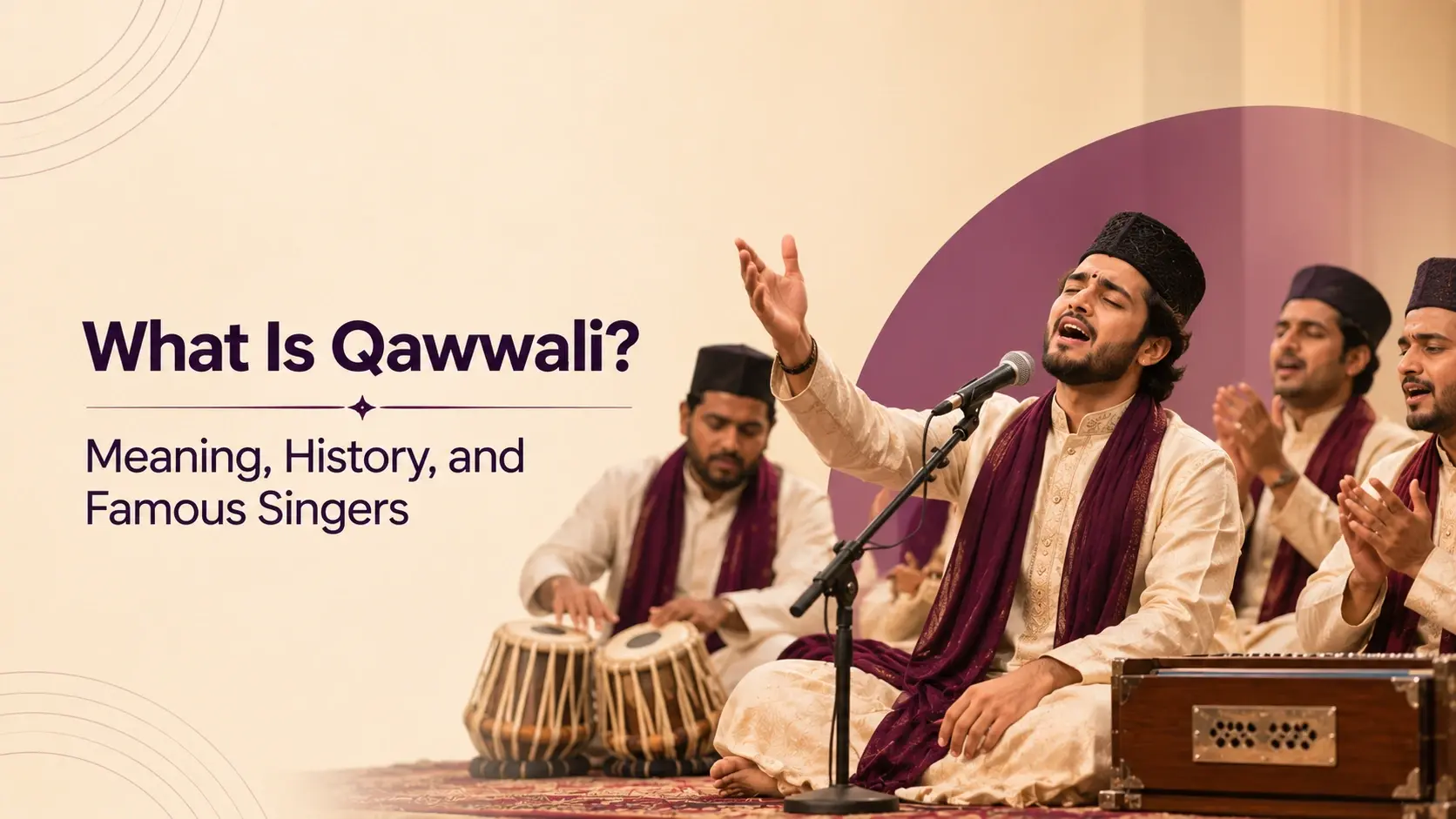
Table of Contents
Quick Summary
| Qawwali is a type of devotional music from South Asia, performed in a group with poetry, hand clapping and modest instruments. The name of the music comes from the Arabic expression for “utterance” or “saying” (“qaul”). It originated in the Chishti Sufi form around the 13th century, in the lineage of the poet, scholar and musician Amir Khusrau, in the dargahs, and is a medium to display divine love and desire. In a crescendo with lead vocals, and followed by a chorus, qawwali music aims to inspire ecstatic spiritual states. The legendary singer Nusrat Fateh Ali Khan and the Sabri Brothers are among its well-known practitioners. |
Introduction
Have you ever listened to a song that begins softly and then, after a few minutes, gives you goosebumps? Well, the chances are that it was a qawwali. But, what is qawwali? It’s Sufi devotional music from South Asia, where a bunch of singers use poetry, repetition and handclaps to gradually ratchet up the emotion until it feels like a prayer.
You may have heard it in a Bollywood movie or a Nusrat Fateh Ali Khan song and wondered, Why does it sound so powerful? Qawwali is one of the most moving types of indian music, and in this blog you will learn its meaning, history, structure, instruments, famous singers and a few songs to start listening to.
What Is Qawwali? Meaning and Definition
Qawwali is the art form of devotional music from the Indian subcontinent, and is performed in primarily India and Pakistan. It is a group performance and may be led by one main singer. Typically sung in praise of God, Prophet and Sufi saints, a qawwali performance is not really a performance. It attempts to establish a transcendental communication between the singers and the audience.
What Is the Meaning of Qawwali? (Origin of the Word “Qaul”)
Qawwali is derived from the Arabic word qaul, which means a statement, a remark, or a phrase. In the Sufi tradition, a qaul is a sacred or wise phrase, and singers who perform sacred phrases in musical form became known as qawwals, and the tradition of singing this phrase as qawwali was formed.
So the meaning is close to “the art of singing sacred sayings”. And that also explains why the lyrics are so important in a qawwali. The poetry is the core of what is done, the music is there just to support it.
What Is Qawwali in English? (Sufi Devotional Music)
Wondering What is qawwali in english? A very simple answer to this question would be “Sufi devotional music”. It can be imagined as religious lyrics created in the form of verses of rhythm and rhythm and performed. Sufism is the mystical side of Islam, emphasizing the love, humility, and a personal link with God and qawwali is the music form in which this path has been transmitted.
Here’s an easy way to remember it:
- Qawwali is an art form.
- Qawwal is the singer.
- A Qawwali party is a group that performs together.
What Is Qawwali Music? Key Characteristics
So, what is qawwali and how to recognise it? What are the features that define a qawwali:
- Group singing: A lead singer and chorus sing together in a call-and-response.
- Rhythmic clapping: Hand claps carry the rhythm and draw the audience in.
- Repetition: The main lines are repeated with slight variations, so emotion is added each time.
- Gradual build-up: The song begins softly and slowly rises in pace and intensity.
- Improvisation: Singers sometimes use sargam (the note names, sa re ga ma) and run along freely.
- Poetic depth: The song lyrics can be interpreted as romantic and commitment and longing.
If a song begins softly and gradually becomes a majestic, hypnotic experience, then you are likely listening to qawwali.
History and Origin of Qawwali
Qawwali existed for more than seven centuries. It originated from the cultural interaction of the Persian, Arabic and Indian musical traditions and was largely propagated by the Sufi orders of South Asia.
Amir Khusrau and the Chishti Sufi Tradition
The most common starting point is usually with Amir Khusrau (1253-1325), a poet, musician and the disciple of Sufi saint Nizamuddin Auliya, of Delhi. Often considered the father of qawwali, he helped to mould the sound by combining Persian and Indian musical concepts, and many of its traditional compositions are even attributed to him. How true this can be remains contested, but there’s no doubting his impact.
The Chishti order, to which Nizamuddin Auliya belonged, embraced music as a means to spiritual intimacy. That explains how the qawwali naturally belonged to the Chishti dargahs.
Qawwali at Dargahs and Shrines
Qawwali has been sung for centuries at dargahs, the shrines of Sufi saints. The most renowned are at the dargahs of Nizamuddin Auliya in Delhi and Moinuddin Chishti in Ajmer. A sitting for qawwali performances is referred to as a mehfil-e-sama. The audience comes from diverse communities, sits together, listens and gets emotionally swept away. Many dargahs offer live qawwali performances on Thursday evenings to this day.
How Qawwali Spread Across South Asia and the World
Once the partition happened in 1947, several qawwali families migrated to Pakistan and the art form flourished in both countries. And by the end of the last century, qawwali singers like Nusrat Fateh Ali Khan had made their way into concert halls, film soundtracks and music festivals around the globe. Now, you will find qawwali fans in the UK, USA, Canada and the Gulf, not least among the Indian diaspora.
Is Qawwali Religious? Sufism and Spiritual Meaning
Yes, qawwali does have a religious component, but in essence it is more spiritual than religious. Its premise is from a Sufi perspective, where God is consistently called by the lover as the Beloved, and the spirit is addressed as the lover who wishes to be united.
Meanwhile, people of all different religions and backgrounds and even just the average music lover are able to enjoy the qawwali music. You do not need to be a practitioner of Sufism to understand and admire the poetry, the rhythm and the emotion. If you are just starting out, a good way to begin is by listening with an open mind and just feeling the music. You will begin to understand it thereafter.
Structure of a Qawwali Performance (Opening Alaap, Hamd, Naat, Manqabat, Kalam, and the Gradual Build-Up)
There is a flow in a typical qawwali performance, similar to a story. The following is the most common sequence, simply put:
- Opening alaap: A slow improvised vocal introduction to create a certain atmosphere. Opening alaap: the lead singer will start singing freely and slowly.
- Hamd: A song in praise of God.
- Naat: A song in reverence of the Prophet Muhammad.
- Manqabat: Song in the praise of a Sufi saint or spiritual teacher.
- Kalam: Poetry of great Sufi poets (often by Amir Khusrau, Bulleh Shah or Rumi).
- The gradual build-up: The tempo rises, the claps grow stronger, and the chorus repeats key lines until the climax.
Though all parts may not be present in every performance, this flow provides a helpful map for listening.
What Is a Qawwali Song? Common Themes (Divine Love, Devotion, Longing)
So, what is qawwali song exactly? A devotional poem put to music, sung in a group. The majority of qawwali songs follow one or two exquisite themes:
- Divine love: Love of the beloved and singing to the beloved.
- Devotion: Praise for God, the Prophet and Sufi saints.
- Longing: The ache of separation and the wish for closeness.
- Surrender: Letting go of ego and finding peace.
The words can be quite simple, yet what they say has substance. That is why it is not boring if you repeat one line for several minutes.
Instruments Used in Qawwali (Harmonium, Tabla, Dholak, Hand Clapping)
Since there are only a handful of instruments in Qawwali, they always remain up front. Here are the main ones:
- Harmonium: The lead melodic instrument, typically played by the lead singer or a partner.
- Tabla: The classical pair of drums that beat out the rhythm. In qawwali, may also be used with the dholak.
- Dholak: A two-headed hand-drum that delivers a lively, earthy beat.
- Hand clapping: The most important “instrument” of all. Clapping keeps the pulse and draws the audience in.
And what about the tanpura, the drone instrument that is often heard in Indian classical music? The tanpura isn’t common in qawwali, which uses more rhythms and clapping, but it’s still a wonderful way to hear how the constant note provides a foundation for the singer.
The Qawwali Party: Lead Singer, Chorus, and Instrumentalists
The term for a qawwali ensemble is a party. Every participant knows his part:
- Lead singer: Starts the song, composes it on the fly, and sets the mood.
- Chorus (hamnawa): Repeats the main theme and becomes more powerful by clapping and harmonizing.
- Instrumentalists: Play harmonium and percussion for the singers.
The group operates like a team. One singer might start a line, someone might continue it, and then everyone else chimes in together at just the right time. That kind of tight teamwork is one of the main reasons why live qawwali is so dramatic.
The Hereditary Tradition of Qawwals
Qawwali has traditionally been passed down within families. Here is how this works:
- Learning from elders: Young members learn from their fathers, uncles and senior family members.
- Starting early: Many begin in childhood by sitting in the chorus, listening and slowly joining in.
- Family lineages: Many well-known qawwali families have kept the art alive for generations.
- Gharana-style learning: This family-based system of teaching is similar to a gharana, where knowledge is handed down from one generation to the next.
- What it preserved:
- Old compositions
- The way of improvising
- The manner of performing at dargahs
This is why many qawwals today can trace their musical roots back several generations.
Language and Poetry in Qawwali (Urdu, Persian, Punjabi, Braj, Hindi)
Qawwali is performed in many languages, which reflects its journey across regions:
- Persian: Language of numerous classical Sufi poetry.
- Urdu: Today’s most popular language is qawwali.
- Punjabi: Brought to mind when reading Bulleh Shah and Baba Farid’s poetry.
- Braj and Hindi: Used in compositions associated with Amir Khusrau.
Some qawwalis incorporate more than one language in a single song. If you find the lyrics difficult to understand at every part, don’t worry. It is perfectly fine to follow a brief translation of the song while listening to it.
Famous Qawwali Singers and Groups
1. Nusrat Fateh Ali Khan and the Legends of Qawwali
Your list isn’t complete without Nusrat Fateh Ali Khan (1948-1997). A great-qawwali singer was born into a qawwal family. He was famous for their powerful voice, rapid vocal pathways and passionate style. He popularized this genre around the world in performance and in collaboration.
Other respected names include:
- The Sabri Brothers, who were popular for classics like “Bhar Do Jholi Meri”.
- Aziz Mian, known for his bold, philosophical style.
- Ghulam Farid Sabri and Maqbool Sabri, who carried the Sabri tradition into the later decades.
- Abida Parveen, a celebrated voice in Sufi music.
Contemporary Qawwali Artists
Today, a new generation keeps the tradition alive while reaching modern listeners. Names you may come across include Rahat Fateh Ali Khan, Nizami Brothers and Warsi Brothers. Several younger groups also share live qawwali on streaming platforms and social media, which makes it easier than ever for beginners to listen.
Famous Qawwali Songs You Should Hear First
If you are new, here are five well-loved songs to start with. Each one shows a different side of the art:
1. Aaj Rang Hai
A joyful song, often attributed to Amir Khusrau, that celebrates meeting the beloved. It is a lovely place to start if you want to understand the meaning of qawwali through a happy, colourful piece.
2. Chhaap Tilak
Another composition attributed to Amir Khusrau, in which the singer surrenders everything to the Beloved. It helps answer what is qawwali in english, because you can hear Sufi devotion in simple, graceful words.
3. Mere Rashke Qamar
A modern favourite by Nusrat Fateh Ali Khan that shows what is qawwali music at its most energetic, with fast rhythm and thrilling vocal runs.
4. Dama Dam Mast Qalandar
A popular tribute to the Sufi saint Lal Shahbaz Qalandar, sung in many styles. It shows what is qawwali song in a folk, foot-tapping form.
5. Kun Faya Kun
From the film Rockstar, this track has the calm build-up and spiritual lyrics of a qawwali song, which makes it an easy bridge for beginners.
Qawwali in Bollywood and Modern Music
Qawwali has entered the Hindi film era for ages. Legends have used qawwali in their blockbusters, right in the middle of a dargah or some celebrations. Singers and composers have also incorporated new-age music with qawwali to bring you songs that are contemporary and traditional at the same time.
If you’re a beginner, film may be your first opening into qawwali. If a film song has you hooked, look up its source. You might be in for a new discovery of what is qawwali in english & translated into devotion instead of action. Just be aware that it’s a highly condensed “version” of a full qawwali in performance.
Qawwali vs Ghazal vs Bhajan: Key Differences
Most people can distinguish the three styles easily. The problem is that these three styles are easy to confuse because all of them are poetic and expressive. Here is a simple comparison:
| Feature | Qawwali | Ghazal | Bhajan |
| Main theme | Sufi devotion, divine love | Love, longing, loss | Devotion to a deity |
| Performed by | A group (lead singer and chorus) | Usually a solo singer | Solo or group |
| Mood | Energetic, builds slowly | Soft, reflective | Calm, prayerful |
| Common language | Urdu, Persian, Punjabi, Braj | Urdu | Hindi, regional languages |
| Rhythm | Strong claps and percussion | Gentle accompaniment | Simple, steady beat |
| Audience role | Joins in clapping and responding | Listens quietly | Often sings along |
How to Listen to and Appreciate Qawwali (A Beginner’s Listening Guide)
Qawwali might seem intimidating initially since some songs last as long as ten minutes or even more. Try these simple steps to get you started:
- Start with shorter songs. Pick tracks of four to six minutes and move to longer ones later.
- Read the translation. Knowing the meaning makes the repetition feel richer.
- Notice the build-up. Try to spot the moment when the tempo and claps rise.
- Follow the lead singer. Listen for how they improvise and how the chorus replies.
- Listen live if you can. A live mehfil or a recorded live concert shows the full energy of the art.
- Return to the same song. Each listen reveals a new layer, which is exactly what a good guide to what is qawwali music would suggest.
How to Learn Qawwali Singing
Another question that a lot of beginners ask is whether you can learn qawwali? Well, yes you can, but it takes time. Qawwali is, normally, something you learn from a guru or from a family of qawwals so take it slowly!
Here is a practical path:
Build your vocal base first. Learn pitch, breath control and rhythm, as these skills help in every style of singing.
● Practise with the harmonium. Playing simple melodies helps you stay in tune and understand notes.
● Learn basic taal. Clapping along to common rhythm cycles builds your timing.
● Listen a lot. Absorb the phrasing and emotion of respected singers.
● Practise regularly. Even fifteen to twenty minutes a day builds confidence over time.
If qawwali has made you want to sing or play an instrument yourself, you do not have to wait. Artium Academy does not offer qawwali classes, but it has many other vocal and instrument courses where you can build the same basics of pitch, rhythm and breath control. You can learn through 1:1 live online classes with certified teachers and a GRMP-recognised curriculum, and the skills you pick up will help you in whichever style you explore later. artists. A strong foundation in singing prepares you for any style you wish to explore later.
Conclusion
So, what is qawwali? It is a living tradition of Sufi devotional music that blends poetry, rhythm and community into one powerful experience. You now know the meaning of the word, its journey from Amir Khusrau to modern stages, the roles in a qawwali party and the songs and singers to begin with.
You do not have to understand everything at once. Start by listening, read the translations and let the music grow on you.
Inspired to sing or play an instrument yourself? Book your free 1:1 trial class with Artium Academy and start building your musical foundation with certified teachers, at your own pace.
Frequently Asked Questions
Qawwali is a form of Sufi devotional music from South Asia. A group of singers performs poetry in praise of God, the Prophet and Sufi saints, usually with clapping, harmonium and percussion.
The word comes from the Arabic qaul, meaning a saying or utterance. It refers to the art of singing sacred sayings and poetry.
In English, qawwali is best described as Sufi devotional music, where spiritual poetry is sung in a group with rhythmic clapping and a gradual build-up.
Qawwali is group-based, rhythm-driven and builds slowly towards a high-energy climax. Other Sufi music may be softer, solo or less rhythmic.
A qawwali song is a devotional poem set to music. Its common themes are divine love, devotion, longing and surrender.
No single person invented it, but Amir Khusrau (13th–14th century) is widely credited with shaping the form within the Chishti Sufi tradition.
The most common are the harmonium, tabla, dholak and hand clapping. The focus stays on the voices.
Yes, it is rooted in Sufi spirituality, but it is enjoyed by people of many backgrounds for its poetry, rhythm and emotion.
Nusrat Fateh Ali Khan, the Sabri Brothers, Aziz Mian, Abida Parveen and Rahat Fateh Ali Khan are among the most widely known.
Yes. Start with basic vocal training, rhythm and harmonium practice, listen regularly, and build up slowly with guidance from a trained teacher.